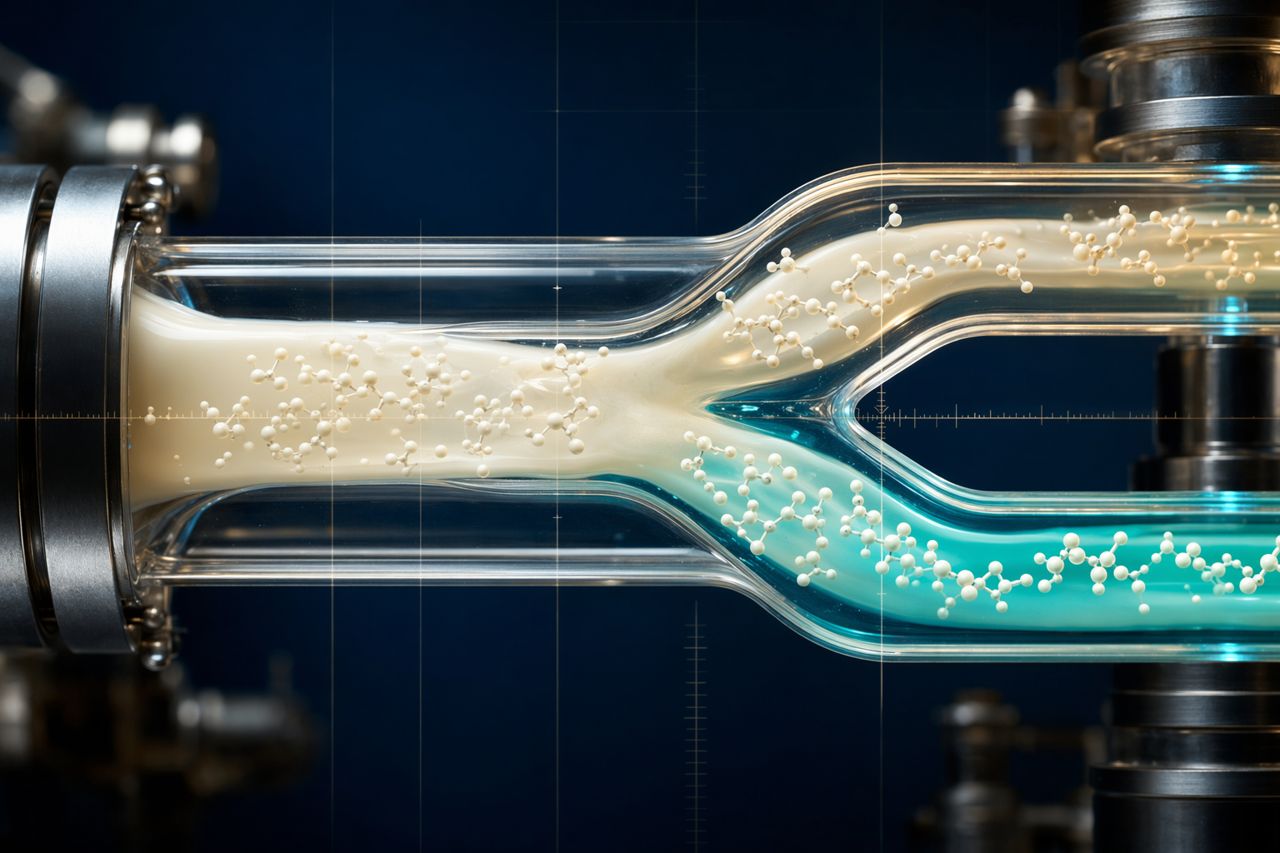
If you want a lactose-free or reduced-lactose product to work on your line, the step you are buying is lactose hydrolysis: lactase, a β-galactosidase, splits the lactose in milk or whey into glucose and galactose, and that is how low-lactose milk and low-lactose dairy products are made. The same reaction earns its keep twice more in ice cream, concentrated milk and evaporated milk, where it lowers the chance of lactose crystallising out and raises sweetness at the same time. The chemistry is the easy part. Supply of this enzyme has become tight, buyers keep switching brand because of it, and each time they are unsure what to compare. This page gives you that comparison: which type fits your product, how each type writes its dose, where batches go wrong, and what to send us so we can work the dose out for your batch.
Request a dosing sheet for your batch if you already know your product and batch size.
What the reaction is worth to a dairy business
Sweetness without added sugar. Shoppers notice the sweetness before anything else: under a dairy brand's short explainer on lactose-free milk, they say they had found the milk sweeter and only now know why. Under a classroom video on the same process, one commenter had never understood where the extra sweetness in the lactose-free carton came from. In a flavoured milk, a yogurt base or an ice cream mix that sweetness is sugar you do not have to add, and it is a risk too, because a batch hydrolysed further than the recipe was built for tastes too sweet.
No sandy texture. Acid lactase is sold for ice cream, concentrated milk and evaporated milk on one promise: less chance of lactose crystallising out, with more sweetness in the same step.
More value from a lactose stream. Whey permeate is a dairy solid important enough to have its own Codex standard, and it goes into chocolate, biscuits, modified milk powder, ice cream and dairy drinks. The acid type is sold for processing whey as well as milk into low-lactose products.
Cost per batch. What you pay per batch is the units of activity you need for the grams of lactose in it, which is why the rest of this page is about units and doses.
Four offers, four ways of writing the dose
| Neutral type | Acid powder, standard strength | Acid powder, high strength | Solid with no unit system named | |
|---|---|---|---|---|
| Sold for | lactose-free liquid milk | formulated milk powder, and drops | ice cream, concentrated and evaporated milk; milk and whey | dairy processing in general |
| Activity as labelled | 5000 NLU/g | 10,000 FCC ALU/g | 100,000 ALU/g | 10,000 u/g |
| Dose as written | 120 NLU per gram of lactose; at 5000 ALU/ml, 1-2 ml per 1 L of milk | at 10,000 ALU/g, 20-25 g per 1 kg of milk powder | 2-5%, to be adjusted to the case; basis not stated | not stated |
| The dose is tied to | the lactose in the batch | the weight of milk powder | nothing you can calculate from | ask |
| pH printed | 6.0-7.2, and 6.5-7.0 beside it | 4.5-5.5 | none | 3.0-8.0, called a working range |
| Temperature printed | 5-50 C, and 35-37 C beside it | 37-55 C, and 38-40 C beside it | optimum 50-55 C | 5-65 C, called a working range |
| Made from | a dairy yeast, Kluyveromyces lactis, by submerged fermentation | the mould Aspergillus oryzae, by submerged fermentation | not stated | a fungal strain: submerged liquid fermentation, then microfiltration, ultrafiltration and vacuum freeze-drying |
| Pack | 1 kg bag | 1 kg pack | 1 kg net | 1 kg bag |
| Shelf life and storage | 12 months; sealed, away from light, best at 0-4 C | 12 months | ask | 12 months; cool, dry, out of sunlight |
Where a label prints two windows side by side, as the first two columns do, it does not always say which is the working range and which is the best point, so ask before you set a tank temperature from it. A working range as wide as pH 3.0-8.0 and 5-65 C tells you where the enzyme still does something, not where it finishes your batch in the hold time you have.
Why one enzyme gets three kinds of dose
Per gram of lactose. The neutral dose is tied to the lactose itself, and the handy per-litre line of 1-2 ml holds only for ordinary milk and only at 5000 units per ml. Lactose is not the same in every base: a viewer who took a dairy class points out under a well-known lactose-free milk video that skim and low-fat milk carry a higher lactose percentage than whole milk and cream, because taking the fat out raises the share of everything else. A skim base, a concentrated milk or a permeate therefore needs its dose worked out again from its own lactose content.
Per kilogram of powder. The standard acid powder is written for formulated milk powder, 20-25 g into 1 kg, at 10,000 ALU/g. Its printed window of pH 4.5-5.5 sits well on the acid side of fresh milk, so it is not the type to stir into a milk tank and wait on. The 10,000 ALU strength is the one positioned for milk powder blends and for drops.
As a percentage. The high-strength acid type, 100,000 ALU/g, carries a suggested addition of 2-5% with a note to adjust it to the case, and says neither what the percentage is a percentage of nor which strength it assumes. For scale, 20-25 g in 1 kg of powder already falls inside a 2-5% band, on a powder a tenth as strong. Treat a bare percentage as the starting point of a small trial, never as a batch instruction.
The unit trap
The neutral type is labelled 5000 NLU/g, the acid powders 10,000 FCC ALU/g and 100,000 FCC ALU/g. NLU and ALU are measured under different conditions, so a bigger number in one is not a stronger enzyme in the other, and no single factor converts between them. Even the usage note on the neutral type slips between the two: the dose is given in NLU per gram of lactose and, in the same sentence, the strength as 5000 ALU/ml. The same product is labelled per gram in one place and per ml in another, so ask whether you are being offered a liquid or a powder before you compare anything. Another offer prints 10,000 u/g and names no unit system at all. Titles shorten it further: one solid is headed with a bare 10,000 and one acid powder with a bare 100,000, with no unit after either. CAS numbers do not settle it either: two of these offers print 9031-11-2 and a third prints 9001-73-4 for an enzyme sold under the same name.
The question buyers keep asking is whether activity or content matters more. Activity per gram or per ml, in a named unit, is the only figure that lets you put two offers side by side. Brand-made "best" concepts are the same trap in nicer clothes: one widely shared warning is about a "golden enzyme value" that sounds premium and has nothing behind it.
The strength ladder is short: 10,000 and 100,000 ALU/g for acid powders, a tenfold step, each in a 1 kg pack. A 50,000 ALU/g powder sits between them, and buyers who reorder mostly take the 100,000 ALU/g. Ten times the strength means a tenth of the weight to ship and store for the same units, and a smaller amount to weigh accurately into a small batch.
How to choose, in order
- Start with the pH of your product at the moment the enzyme has to work: the neutral type prints 6.0-7.2 and the standard acid powder prints 4.5-5.5, and the two do not overlap.
- Fix the unit next: write NLU or ALU beside every activity figure and send back any offer that says only 10,000 or 10,000 u/g.
- Work out the grams of lactose in the batch, because the neutral dose is written per gram of lactose and the 1-2 ml per 1 L line is only a shortcut for plain milk.
- Match the temperature you can hold: the neutral label runs 5-50 C, which covers a cold tank, with 35-37 C printed beside it; the acid powders print 37-55 C and an optimum of 50-55 C.
- Convert the dose to the strength you are buying; a figure given at 10,000 ALU/g does not carry over gram for gram to a 100,000 ALU/g powder.
- Run a small trial and confirm the conversion by measuring glucose: in the classroom version of this process, with the enzyme held in beads, the glucose reading rises on every pass of the milk.
- Decide what the heat step after dosing does to the enzyme, and ask for the window of your grade instead of trusting a rule of thumb.
- Repeat steps one to five whenever you change brand, which tight supply is forcing buyers to do often.
Where batches go wrong
- Comparing units as if they were one scale: 5000 NLU/g against 10,000 FCC ALU/g says nothing about which is stronger.
- Dosing the volume and not the lactose: the 1-2 ml per 1 L line copied onto a concentrate, a skim base or a liquid of another strength gives the wrong dose.
- Reading 2-5% as an instruction when the label itself says to adjust it to the case.
- Using the acid powder, with its printed pH 4.5-5.5, in fresh milk and waiting for a result.
- Buying on a brand's own "value" wording and not on stated activity.
- Swapping brand when stock runs out and keeping the old dose; the mistake is not the swap, it is skipping the re-check.
- Trusting one heat rule for every grade: a common belief, posted under a heat test, is that lactase is denatured above about 57 C and that longer heating makes the loss more permanent. Labels do not line up behind a single cut-off; one acid powder gives 50-55 C as its optimum and one solid claims a working range of 5-65 C.
- Storing it like a dry ingredient: one label asks for sealed, dark storage at 0-4 C, another for a cool, dry place out of sunlight, and both count 12 months from that.
- Overshooting sweetness: glucose and galactose are sweeter than lactose, so a longer hold or a heavier dose than the trial changes the taste of the finished product.
Email us for a dosing sheet
What we can send is acid lactase as a powder in 1 kg packs, at 10,000, 50,000 and 100,000 ALU/g. If your product needs the neutral type, ask about neutral liquid grades and we will tell you plainly what we can and cannot supply. Email us through the form below and ask for a dosing sheet: we work out by hand which strength fits and how much of it your batch takes.
Send us:
- the product (milk, ice cream mix, concentrated milk, milk powder blend, whey or permeate)
- batch size in litres or kilograms
- lactose content in percent, if you know it
- pH of the product at the point of dosing
- hold time and temperature you can give the enzyme
- the residual lactose you are aiming for